
Energy Management Consoles
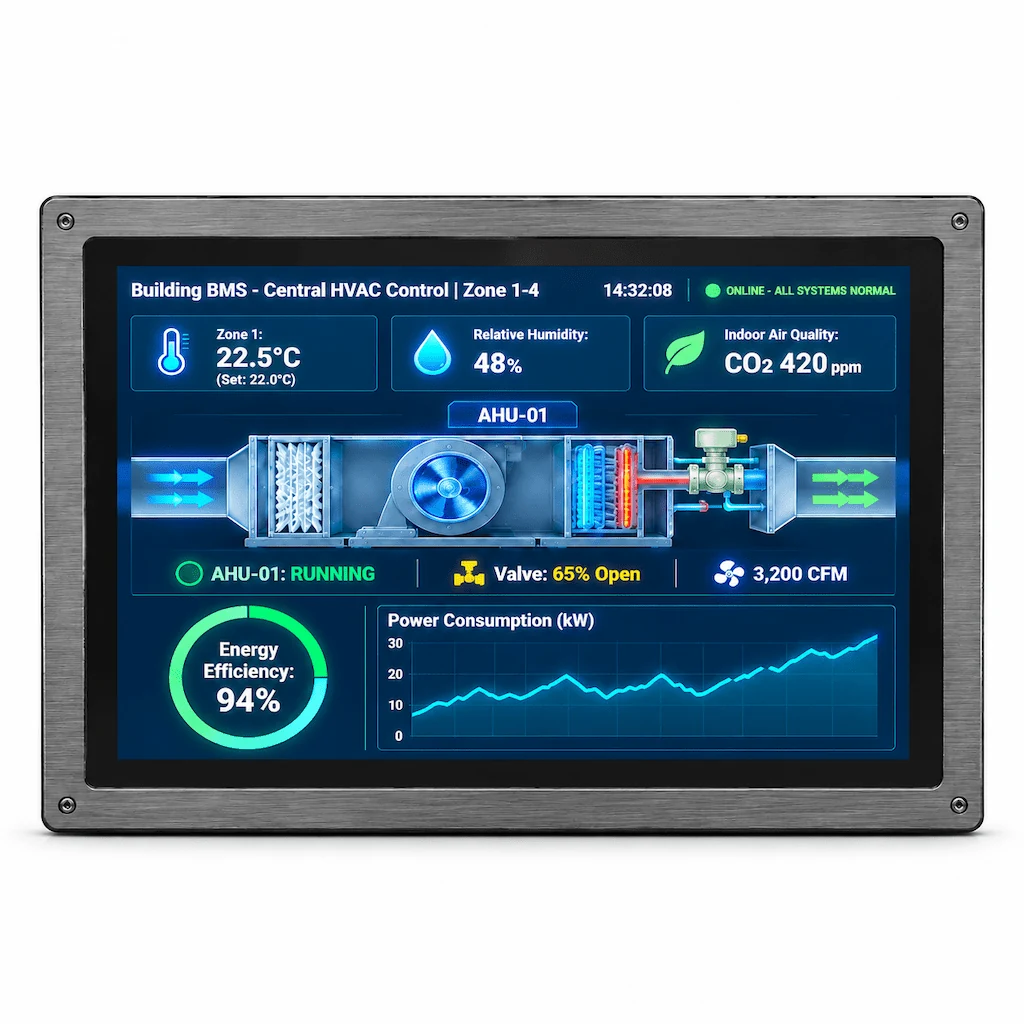
A nearly flat HMI for electrical cabinet doors and control panels. The DO-IND family is built around a defined panel cut-out, industrial serial I/O and a fanless die-cast enclosure.
Also specified as: machine HMI · electrical cabinet door · panel PC · compact Android touch panels.
Cabinet-door consoles use DC 12-36 V wide-voltage input and are not PoE devices. Protocol support is application-level, not a certified hardware feature.
What this application needs from the hardware.
These are the capabilities that matter for energy management consoles projects, taken from the specification of the models below.
3 mm super-thin front bezel and a pure flat panel. Defined cut-outs: W276.2 x H176.2 mm on DO-IND-101 and W403 x H252 mm on DO-IND-156.
Dust-proof and waterproof front panel, fully enclosed die-cast aluminium alloy housing, -10 to 60 C operating range (a -20 to 70 C build is listed as customizable on DO-IND-101).
DC 12-36 V input with a 24 V / 2.5 A adapter. These panel-mount consoles are not PoE devices.
RS-232 / RS-485 / RS-422 / CAN via Phoenix terminals, DB9 COM, USB, HDMI output up to 4K and gigabit Ethernet. Protocol stacks such as Modbus run in your application software.
RK3568 with a 1 TOPS NPU, running Android 12 / 14, Linux 5.10, Ubuntu 20.04 / 22.04 or Debian 11.
Recommended models.
Start from a documented configuration, then confirm the option list and firmware build for your project.
Mounting, power and physical I/O.
mounting
Panel-mount into a cabinet door using the specified cut-out. Wall-embedded, VESA, desktop and suspended options are also listed.
power
DC 12-36 V wide-voltage input (24 V / 2.5 A adapter). No PoE.
interfaces
Phoenix terminal (RS-232 / RS-485 / CAN), DB9 COM, USB, HDMI output, gigabit LAN, audio and GND.
Interfaces, sensors & the system API for energy management consoles.
The hardware is available to your app, not just to the screen. The peripherals below come from the specifications of the models on this page.
Wired I/O, readers & control ports
Serial, CAN, relay, GPIO, IR and NFC / RFID interfaces are part of the hardware rather than USB dongles.
On-board sensing and status light
Ambient light, temperature / humidity and G-sensor readings, plus the RGB LED status bar where fitted.
Sensors can be added as a project build option for this configuration.
Peripheral access from your own app
A system API exposes the built-in peripherals to your own Android application: read the on-board sensors, drive the RGB LED status light bar and control the wired interfaces – RS-232 / RS-485 / RS-422 / CAN, relay, GPIO, IR and NFC / RFID readers.
The API reference and the supported call set are supplied for the firmware build confirmed with your order. Tell us which peripherals your application needs to read or control and we will confirm the mapping for that model.
Additional interfaces, sensor types and LED light bar layouts can be specified for volume projects alongside enclosure, firmware and branding work. Tell us which peripherals your app needs →
Questions for this application.
How flat can it sit on the cabinet door?
The front bezel is 3 mm and the panel is pure flat. The two standard cut-outs are W276.2 x H176.2 mm and W403 x H252 mm. Send us the door thickness and we will supply the mechanical drawing.
Can we power it from 24 V DC in the machine?
Yes. The DO-IND family accepts DC 12-36 V wide-voltage input and a 24 V / 2.5 A adapter is listed. These models are not PoE.
Does it speak Modbus?
The hardware provides RS-232 / RS-485 / RS-422 / CAN and Ethernet. Protocol stacks such as Modbus are implemented in your application software; tell us the stack and we will confirm the port mapping.
Can we mount it nearly flat in a 2 mm stainless steel front panel and power it from 12 V DC in our machine?
For a machine HMI inside a housing, the 3 mm front bezel sits nearly flat on a cabinet door and the DC 12-36 V input covers 12 V and 24 V machine supplies. These are not PoE devices. Send the panel thickness, cut-out and rear-depth limit and we will confirm the fit before you order.
Can our HMI software reach the serial ports and CAN bus through a system API?
Yes. A system API is provided for the Phoenix terminal, DB9 COM, RS-232 / RS-485 / RS-422 / CAN, GPIO and Ethernet. Protocol stacks such as Modbus stay in your application; we confirm the port mapping and the supported calls for your firmware build.
Ask about Energy Management Consoles.
This page’s model or application is already attached to your enquiry. Add quantity, mounting surface, the interfaces, sensors, LED bar and system API calls you need.
Standard models, build options and project customization are confirmed with your quotation.